Saturday, December 29, 2007

Toning --What Women Want!


Toning

The most frequent question I get asked by women is “what exercises should I do if I want to tone my body?” Some of the most common body parts that women want to tone are triceps (upper arm area), the mid-section (the “muffin-top” -- stomach and love handles) and of course the butt and thigh areas.


Here’s my input on Toning:

Muscle tone is a term that we use to describe a body part that has a minimal amount of fat covering lean muscle tissue. When a muscle is not covered by layers of fat, it will appear closer to its actual shape and therefore appears “toned.” The body part will have shape and definition to it and will appear healthy and strong. Some people consider a muscle covered by fat a “bulky” muscle. I just call it fat.


It’s important to note that it’s not the actual muscle tissue that gets fat and bulky, it’s the layer of fat around it that gives it that form. If your eating habits do not support fat loss, then no amount of exercise will help you achieve a toned look. It all depends on how much fat tissue you’re carrying and how much of it is covering your lean muscle tissue. But you do have to have some muscle -- the more lean muscle you have, with the least amount of fat covering it, the more toned your body will appear.


It’s also not about what exercises help you tone the body. It’s about the amount of body fat vs. lean tissue. Exercises to magically shape and tone your muscles are non-existent; the same is true for exercises that are supposed to build big, bulky muscles. This is just one of the myths that we’ve been led to believe.


The real way to achieve a tight, toned body is to make healthier choices in the kitchen and every time you pick up a fork. If you add resistance training to your regimen and some interval-based activities, such as sprints on the bike or in the swimming pool, you’ll get that toned body you want.

Friday, December 21, 2007

Invest Today – Reap Rewards Tomorrow


Invest in your health today and you’ll get a huge return on your health tomorrow. By investing today, you reduce the risk of dying prematurely, you enhance the life you’re living today, and you’ll look and feel your absolute best.

Investing in your health is not the same as investing in the stock market. Getting a 10%-15% return on your stocks is nice, but it’s risky. It doesn’t begin to compare with actually feeling young instead of just wishing you where.

I’m not talking about a financial investment here. I’m talking about all the choices you’ve made and lifestyle habits you’ve adopted over the years. Five years from now, will your choices have a good rate of return or will you be facing harsh reality?

If you start investing 1% in your health each day, starting today, sixty days from now you will have a 60% return on your investment – and it’s risk free!

Not bad, eh?

Ruslan

Wednesday, December 19, 2007

Eating Healthy - Easy or Hard?


Last night I was interacting on one of the forums, when I came across a thread where someone said, “Eating is the easy part, training is the real challenge.” Then the person went on to say that people should get over the eating part and just do it, that the real test is under the iron bar at the gym.

I disagree with him and here’s why:

Eating is a psychological game.

People turn to food for comfort. They turn to food when dealing with emotions; when things go well, they turn to food for reward. Those who had to fight the battle of losing fat know how difficult and challenging it can be. It’s a very different type of a battle than trying to add a few extra pounds of lean muscle.

Another important consideration is that training lasts about 45-60 minutes on average, whereas nutrition lasts the whole day (about 15 hours). For the most part, people can handle the physical challenge in the gym for 60 minutes a couple of times a week, but things get tough when they have to stick to a new nutritional plan for their whole lives.

Adapting to a new lifestyle and new eating habits is hard. Switching from your favorite foods, which probably consisted of packaged junk food with minimal nutritional value, to having to cook your own food and preparing meals in advance, can be overwhelming. This is what makes the eating part hard for most, harder than the exercising part. Also, getting used to tasting food that is closer to its natural state is difficult for most people.

As hard as it is adapting to a new set of habits, it isn’t impossible if you have the will.


Four tips on how to make this work for you:

  1. Social Support: sharing cooking recipes, supporting each other during the tough times and celebrating your wins with friends is important.
  1. Kitchen set-up: you should not have any temptation foods in your house. Foods that don’t support your goals and your new nutritional habits should not be around. If the food is available, you know you will eventually eat it.
  1. Execution (Follow-through?): that vision you have created for yourself has to be backed up with action. Make sure that your current habits match your dream. If your dream is a physical transformation, then having sugary cereal for breakfast does not support that dream.
  1. Consistency: don’t expect changes to just happen – you have to make them happen, slowly, a step at a time, but with commitment and regularity.


Wrap-up:

In order to make this work for you, you’ll have to work at it yourself. Visualize your goal and think of all the great things to come when you achieve it. Strategize for success, stay consistent and be excellent!

Tuesday, December 18, 2007

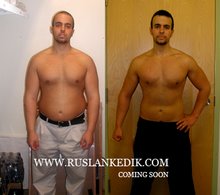
Body Transformation


Lately I’ve been approached by people who ask the same question: how am I able to get my clients to lose fat and build muscle.

One of my current clients has been getting many compliments lately and he has definitely earned them. He has gone from a size 40 pant size to a 32 in about 8 months. If no one commented (or noticed) the progressive change as he melted his unwanted body fat from size 40 to 38 to 36 and so on, they’re definitely noticing now.

The fact that people have only started to notice the change in his body doesn’t mean it’s because of what he’s doing right now. The question that was put to me was “what is he doing differently?” Has his nutrition changed or his training changed in the last few weeks?”

My answer is – nothing has changed in the last few weeks. The client’s current health and body composition is a reflection of all the choices that he has been making over the last 8 months. He’s adopted some new lifestyle habits that simply support his goals. He followed through on them and today he’s reached them.


Think about where you want to be a year from now. How do you want your body to look? How do you want to feel? Adopt habits that support your goals. If you don’t take action today, you won’t see any changes tomorrow.

Sunday, December 2, 2007

Motivation

Excellent concepts on motivation from Dr. Jonny Bowden and strategies to help you progress with your goals.